European Christmas markets run from late November through December. They cost almost nothing to visit, entry is free, you pay only for what you eat and drink, and they turn ordinary city centres into something that looks genuinely different.
This guide covers the cities worth travelling for, how long to spend in each, what to eat, and a few ways to combine markets with concerts and other events in the same trip.
What makes a Christmas market worth travelling for
Most cities have Christmas lights. A good Christmas market adds something more: a temporary village of wooden stalls selling hand-crafted goods, local food and mulled wine, usually clustered around a cathedral or medieval square that looks the part.
The best markets feel specific to their place. Strasbourg smells of bredele biscuits and vin chaud. Vienna sounds like a chamber orchestra. Cologne has six separate markets within walking distance of each other. That specificity is what justifies the trip.
- ✅ Weekday visits: far less crowded than weekends, if your schedule allows, arrive Monday to Wednesday
- ✅ Late afternoons: most markets look best after dark, from around 5pm, plan accordingly
- ✅ Budget reality: entry is free, but vin chaud (€3-5), food (€5-12 per dish) and crafts add up quickly
Strasbourg: the reference point
Strasbourg's Christkindelsmärik is one of the oldest Christmas markets in France, dating back to 1570. The city's Alsatian architecture, half-timbered houses in the Petite France district, the Gothic cathedral, forms a backdrop that's hard to match elsewhere.
The market typically opens in late November and runs until December 24th. The exact 2026 opening dates will be confirmed by the city of Strasbourg in autumn. Strasbourg's main Christmas market is split across several squares: Place Broglie, Place de la Cathédrale, Place d'Austerlitz and the banks of the Ill river.
- 🥨 Eat: bredele (Alsatian spiced biscuits), tarte flambée, butterbretzeln
- 🍷 Drink: vin chaud (mulled wine), mulled beer
- 📍 Don't miss: the giant Christmas tree on Place Kléber, usually 30m tall
- 🚂 Getting there: direct TGV from Paris in 2h15; Eurostar via Paris from London in around 5h total
Strasbourg is also a good base for day trips. Colmar is 45 minutes by TER regional train. The Alsace wine route runs between the two cities and several villages worth stopping in sit along it.
Colmar: smaller scale, stronger local atmosphere
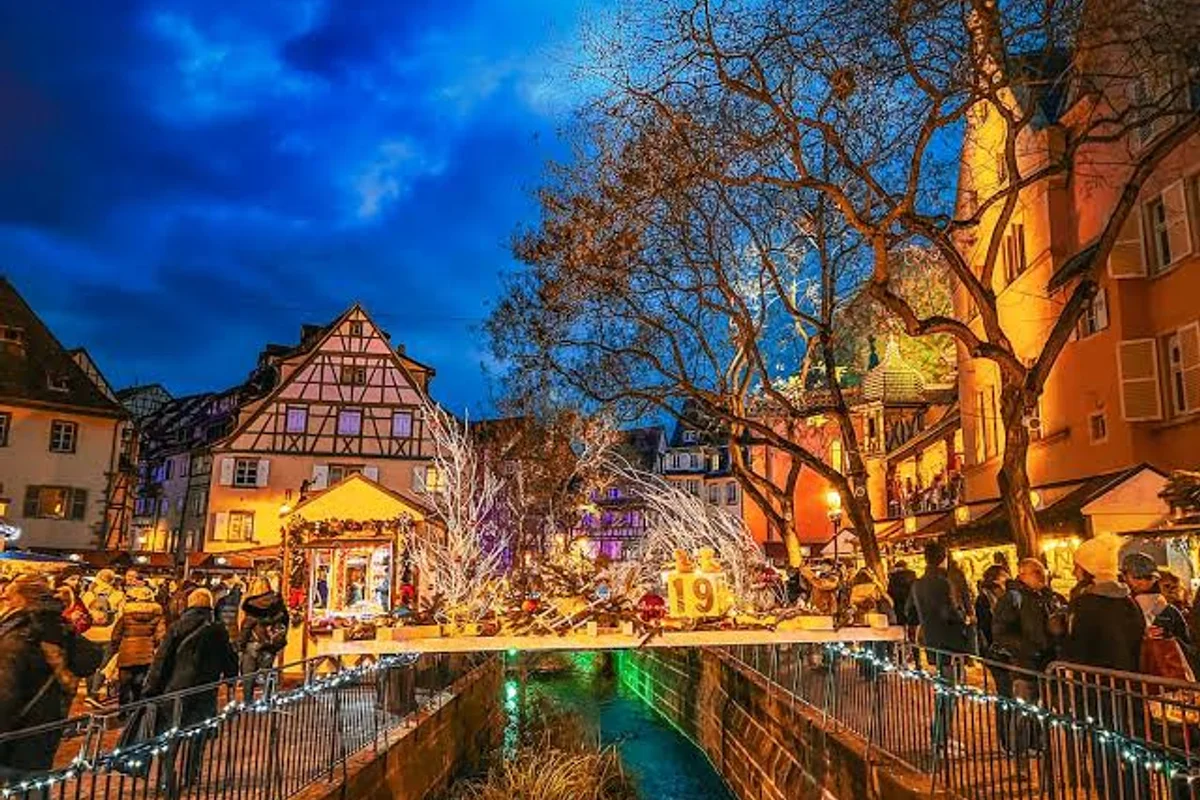
Colmar's Christmas market draws fewer visitors than Strasbourg but the setting is comparable. The Petite Venise quarter and the old town are free of modern buildings in the market area, giving it a more intimate feel than a big city market.
Colmar's market typically runs across five different themed areas in the town centre, each with a slightly different character. Dates for 2026 are to be confirmed on the city's official website. Combined with a day in Strasbourg, Colmar makes an easy two-day Alsace itinerary.
Vienna and Prague: central European alternatives
Vienna's Christmas market in front of the Rathaus (City Hall) is the most prominent in Austria. The building is floodlit, the stalls sell high-quality local crafts, and the classical music programme runs throughout December. Vienna also has smaller markets in the grounds of Schönbrunn Palace and on Spittelberg, each with a different atmosphere.
Prague's Old Town Square market centres on the Orloj astronomical clock and the massive Christmas tree. Temperatures in Prague in December regularly drop below zero, which makes the glühwein stalls feel necessary rather than optional. Both Vienna and Prague markets typically open in late November, confirm exact 2026 dates on city tourism websites.
- 🏰 Vienna Rathaus: classical music stage, high-craft stalls, opens usually late November
- 🏰 Schönbrunn Palace: smaller, less crowded than the Rathaus, imperial grounds as backdrop
- 🏯 Prague Old Town Square: the Orloj clock tolls every hour, crowds are dense at weekends
- 🏯 Prague Wenceslas Square: more local, less touristy than Old Town
Northern Europe: Bruges, Cologne and beyond
Bruges in Belgium runs a market and ice-skating rink in the Markt square and Simon Stevinplein. The medieval city centre is compact, you can cover the main sites in a day, making it work well as part of a Brussels or Ghent trip.
Cologne has six separate Christmas markets within walking distance of each other in the city centre, including the one directly in front of the cathedral. It's one of the most visited in Germany. The train journey from Brussels takes under 2 hours on Thalys.
For a deeper look at German markets beyond Cologne, the Oktoberfest and German volksfests guide covers the broader German festival calendar with city-by-city context.
Combining a Christmas market trip with a concert
Strasbourg in mid-November offers a combination: the market opens in late November, but a Gims concert plays earlier in the month at the Zénith de Strasbourg Europe.
Gims (Maître Gims) en concert à Strasbourg
📅 Date: 17 November 2026
📍 Venue: Zénith de Strasbourg Europe, Strasbourg, France
The Zénith is a 10-minute tram ride from the city centre. A Gims concert on November 17th works as part of a 3-day Strasbourg trip: concert on the first evening, market exploration over the following days. The main Christmas market stalls are typically already setting up by mid-November.
The Radio City Rockettes in New York run on a similar model for those planning a transatlantic trip, a holiday spectacular combined with a seasonal city atmosphere.
Christmas Spectacular Starring the Radio City Rockettes 2026
📅 Date: from 4 November 2026
📍 Venue: Radio City Music Hall, New York, NY
💰 Price: from $51
Practical tips: when to go, where to stay, what to spend
First week of December is the sweet spot for most markets: fully operational, not yet at peak weekend crowds. The weekend of December 7-8 and the final weekend before Christmas are the two most crowded periods.
- ✅ Book accommodation 2-3 months ahead: Christmas market weekends fill hotels in Strasbourg and Colmar by September
- ✅ Use regional trains: Alsace and Bavaria have dense rail networks, no car needed for market-hopping
- ✅ Layer for the cold: Strasbourg in December averages 3°C with damp air from the Rhine; thermal layers make the difference
- ✅ Bring cash: many artisan stalls don't take cards
- ✅ Buy on the first visit: popular handcrafted items sell out; don't plan to 'come back later' for something you liked
For the full logistics of a multi-city European trip combining several events, how to plan a multi-event trip covers the booking order, routing and budget logic.
Stay connected on the go
An eSIM gets you online the moment you land — no need to swap your SIM card.