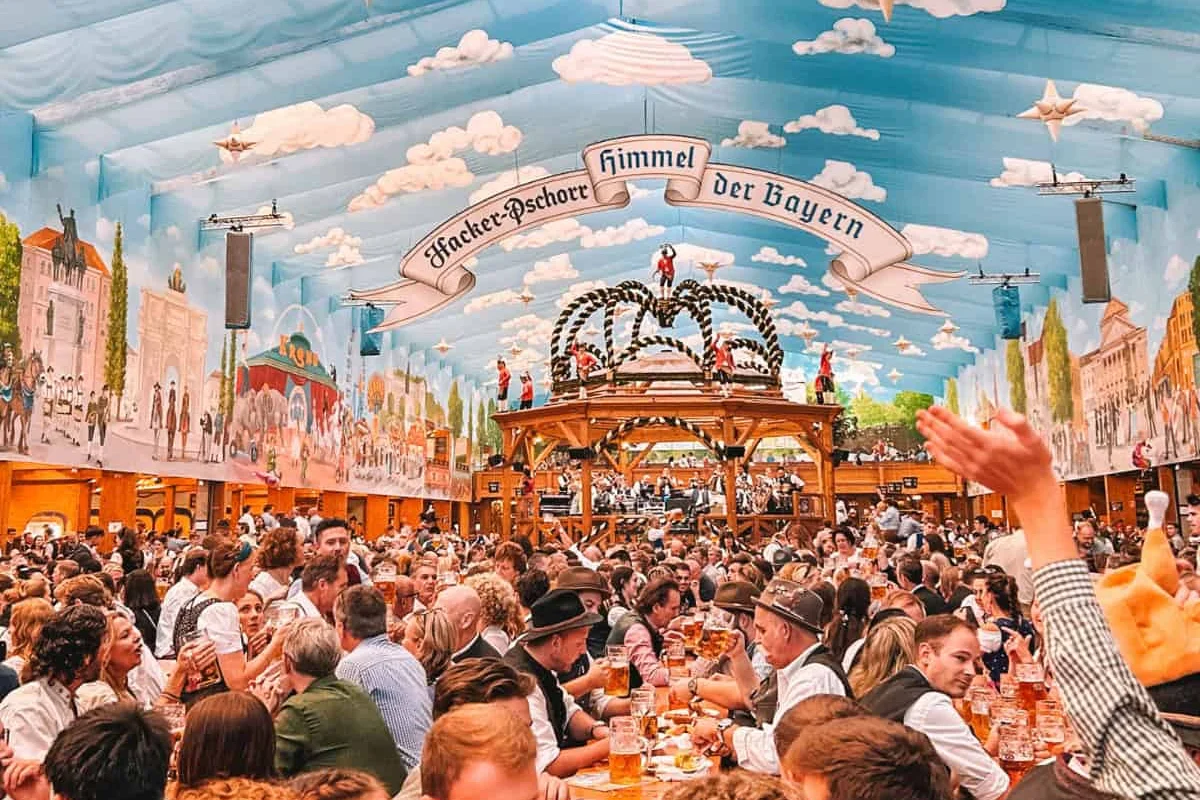

Oktoberfest is the world's largest folk festival. Over 16 days each September and October, more than 6.5 million visitors descend on the Theresienwiese : the Wiesn : in Munich to drink beer from one-litre Masskrug steins, eat pretzels the size of steering wheels and dance on benches to brass bands playing Bon Jovi.
If you've never been, nothing quite prepares you for the scale of it. But it's also surprisingly manageable with the right preparation. This guide covers everything a first-timer needs to know for Oktoberfest 2026.
What Is Oktoberfest? A Brief History
Oktoberfest began in 1810 as a horse race to celebrate the wedding of Crown Prince Ludwig of Bavaria to Princess Therese of Saxony. The festivities were such a success that they became an annual tradition. The beer tents arrived in the 1880s. Today, the event generates over €1.3 billion in revenue and attracts visitors from more than 90 countries.
- 🍺 6.5 million visitors over 16 days in 2025 : one of the world's largest events
- 🍺 7+ million litres of beer consumed annually on the Wiesn
- 🍺 14 large beer tents and around 20 smaller tents operated by Munich's major breweries
- 🍺 Free entry to the festival grounds : you only pay for what you eat and drink
Oktoberfest 2026: Dates and Location
Oktoberfest München 2026
📅 Dates: Saturday 19 September – Sunday 4 October 2026 (16 days)
📍 Location: Theresienwiese (Wiesn), Munich, Bavaria, Germany
💰 Price: Free entry to the grounds | Beer: ~€15–€16 per Masskrug (1 litre)
The festival always opens on the third Saturday of September and runs for 16 days, ending on the first Sunday of October. The opening ceremony is at 12:00 noon on September 19, when the Mayor of Munich taps the first barrel in the Schottenhamel tent and shouts 'O'zapft is!' (It's tapped!) : the signal for beer service to begin across all tents.
The Theresienwiese is a 42-hectare meadow in central Munich, accessible by U-Bahn (lines U4 and U5 to Theresienwiese station). There is no parking on site : public transport is the only practical option.
The Beer Tents: Where to Sit
The 14 large tents are operated by Munich's six main breweries: Augustiner, Hofbräu, Paulaner, Hacker-Pschorr, Spaten-Franziskaner and Löwenbräu. Each has its own character, music style and loyal following. As a first-timer, the most important thing to know is this: without a table reservation (Tischreservierung), you cannot get a seat in the tents in the evening or on weekends.
- 🏕️ Hofbräu-Festzelt: the most touristy and internationally famous : loud, fun, rarely a local in sight. Great for first-timers
- 🏕️ Augustiner-Festhalle: the locals' favourite : Augustiner serves its beer from traditional wooden barrels (Holzfass), the only tent to do so
- 🏕️ Schottenhamel: where the opening ceremony happens; skews younger and student-heavy on weekday afternoons
- 🏕️ Käfer's Wiesn-Schänke: smaller, more upscale tent : celebrity-heavy, requires advance booking, higher prices
- 🏕️ Reserved tables: book via the official tent websites 6–12 months in advance for prime evening slots
Walk-in strategy: arrive at 9–10am on a weekday. Most tents open at 10am (noon on weekends) and unreserved tables fill up fast. Weekdays in the first week and the final days of the festival are significantly less crowded than weekends.
What to Wear: Dirndl, Lederhosen and What's Expected
Traditional Bavarian dress is not mandatory but it's strongly encouraged : and most visitors, locals and tourists alike, wear it. Showing up in jeans and a t-shirt won't get you turned away, but you'll stand out in the wrong way inside the tents.
- ✅ Women: Dirndl : dress with apron; length below the knee is the traditional Munich style; €50–€200 for a decent ready-to-wear version
- ✅ Men: Lederhosen : leather shorts (short or knee-length) with suspenders and a checked shirt; €80–€250 for a quality pair that lasts years
- ✅ Where to buy: Kaufhof and H&M have affordable versions; specialist shops on Kaufingerstrasse and Marienplatz for higher quality
- ✅ Online: order at least 4 weeks in advance from German retailers (Lekra, Trachten Angermaier) : better quality, better prices than tourist shops
- ✅ The apron bow matters: on a Dirndl, a bow tied on the left means single; right means taken or married : Munich women take this seriously
Getting to Munich from France
Munich is well connected by train from France. The fastest option from Paris is a direct TGV or ICE, though one change in Stuttgart or Frankfurt is often cheaper.
- ✅ By train (Paris): Paris-Munich in 5h30 direct (via Strasbourg); or Paris-Stuttgart (2h) then ICE to Munich (2h15) : from €49 one-way booked in advance
- ✅ By train (Lyon): Lyon-Munich via Strasbourg or Zurich, around 5h : fewer direct options but straightforward
- ✅ By plane: Paris CDG, Lyon or Bordeaux to Munich Airport (MUC) from €40–€100 one-way; airport to city centre: S-Bahn 40 min
- ✅ From the airport to the Wiesn: S1 or S8 to central station (Hauptbahnhof), then U4/U5 to Theresienwiese : 50 min total, or a pre-booked private transfer straight to your hotel
- ✅ On foot from Hauptbahnhof: 15 minutes walking south : many prefer the walk during festival hours
Oktoberfest 2026: What It Actually Costs
Entry to the festival grounds is free. Your spending starts at the tent. Budget honestly : beer is expensive and it's the main activity.
- 🍺 Masskrug (1 litre beer): ~€15–€16 in 2026 (prices rise ~3–5 % each year)
- 🥨 Pretzel (Brezn): €5–€8
- 🍗 Half roast chicken (Hendl): €16–€22
- 🪑 Table reservation deposit: varies by tent; often €10–€30/person, redeemable as food/drink credit
- 🏨 Hotel in Munich during Oktoberfest: €200–€500/night : book months in advance; consider staying in a suburb served by U-Bahn
- 🛏️ Hostel: €60–€120/night during peak Oktoberfest weekends
Find a place to stay in Munich
Munich hotels sell out months ahead: compare prices, including suburbs on the U-Bahn.
Realistic budget for a weekend trip (including travel from France): €400–€700 per person. A day trip budget from Munich: €60–€100 for food, drinks and transport.
Tips for First-Timers: What Locals Don't Tell You
- ✅ Go on a weekday : Tuesday to Thursday in the first week is significantly quieter; you'll get a table and actually talk to people
- ✅ Book accommodation 6 months+ in advance : Munich hotels are sold out within days of Oktoberfest dates being announced
- ✅ Drink water between Masskrugs : the Bavarian brewing tradition produces strong lager; pacing matters
- ✅ Leave valuables at the hotel : the Wiesn is crowded; pickpocketing is common in the tents
- ✅ The beer garden outside is free-standing : you can buy at the kiosk and sit outside without a reservation
- ✅ Bring cash : many food stalls and smaller tents still prefer cash; ATM queues get very long
- ✅ The Oide Wiesn : a quieter, more traditional festival within the festival; separate ticket (€5), held in the southern part of the grounds, quieter folk music and historical rides
- ✅ Travel insurance : worth having for medical costs and trip cancellation on a trip to Germany
Planning other European events for autumn 2026? Our festival budget guide helps you plan the full cost of any trip. And check the Go Live It events calendar for the best events across Europe this season.