
Oktoberfest is the most visited folk festival on earth, drawing over 6 million visitors to Munich's Theresienwiese each fall. It is also not typical of German folk festival culture.
Germany's Volksfeste are regional, rooted in local tradition, and most welcome visitors without the international booking pressures and prices that come with Oktoberfest.
What a Volksfest is
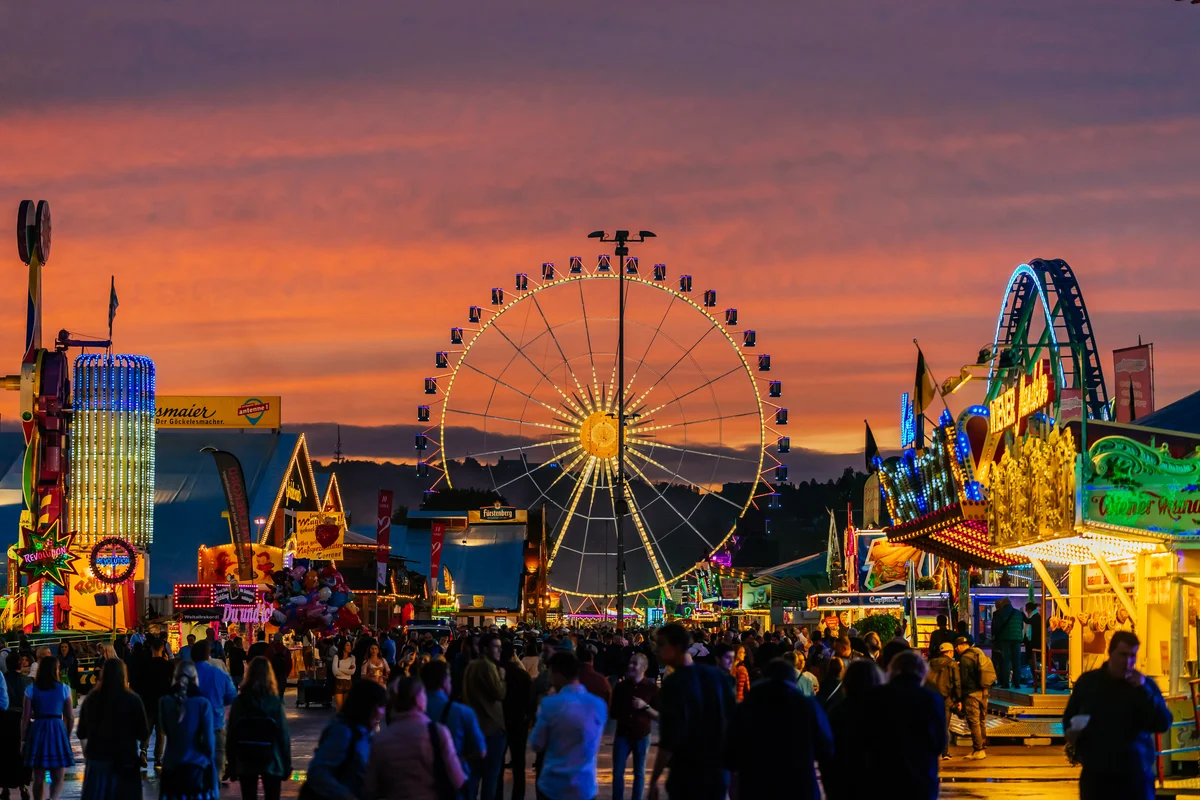
A Volksfest : literally a people's festival : is a German folk festival that typically combines fairground rides, beer tents, regional food, traditional music and a fair or market. Germany has over 1,300 of them each year, ranging from local two-day events to major multi-week festivals that rival Oktoberfest in scale.
- 🍺 Beer tents: the heart of most Volksfeste. Local breweries or regional brewers set up large marquee tents with long tables, traditional bands and 1-litre Mass glasses.
- 🎡 Fairground rides: roller coasters, ferris wheels and traditional fairground stalls are part of every major Volksfest.
- 🎵 Oompah bands: traditional Bavarian and regional brass bands play live in the tents. More regional festivals feature local folk music rather than the tourist-facing Munich style.
- 🥨 Regional food: Hendl (roast chicken), Steckerlfisch (grilled fish on a stick), Brezn (pretzels), Schmalznudeln, and regional specialities that vary by city.
Unlike Oktoberfest, most regional Volksfeste do not require advance reservations for tent seating. Showing up and finding a seat at the table is the norm.
Stuttgart Cannstatter Wasen: September-October 2026
The Stuttgart Cannstatter Wasen is Germany's second-largest Volksfest after Oktoberfest, drawing around 4 million visitors annually. It is held at the Cannstatter Wasen meadow beside the Neckar River, running for three weeks each fall.
- 📅 Dates: September 25 to October 11, 2026 (confirm at cannstatter-volksfest.de)
- 📍 Location: Cannstatter Wasen, Bad Cannstatt, Stuttgart
- 🎟️ Admission: free to enter the fairground. Beer tents have no cover charge; Masskrug (1-litre beer) typically costs €13 to €16.
- 🚂 Access: S-Bahn lines S1, S2, S3 to Bad Cannstatt station from Stuttgart Hauptbahnhof. 10 minutes.
Stuttgart is a major automotive city (Mercedes-Benz and Porsche are both based here) with good hotel infrastructure. Combining Wasen with a visit to the Mercedes-Benz Museum or the Porsche Museum makes a strong 3-day trip.
Nürnberg Herbstvolksfest: September-October 2026
Nürnberg's Herbstvolksfest (autumn folk festival) runs across the city's traditional Volksfestplatz fairground. It is Bavaria's second-largest folk festival after Oktoberfest, with around 1 million visitors over two weeks.
- 📅 Dates: September 18 to October 4, 2026 (confirm at nuernberg-volksfest.de)
- 📍 Location: Volksfestplatz, Nürnberg
- 🎟️ Admission: free to enter. Beer by the Masskrug from around €14.
- 🚂 Access: Nürnberg Hauptbahnhof is well-connected from Munich (1h via ICE), Frankfurt (2h) and Berlin (3h15). Tram from the station to Volksfestplatz.
Nürnberg's old city : one of the best-preserved medieval city centres in Germany : is worth 2 to 3 days of exploration alongside the festival.
Hannover Schützenfest: July 2026
The Hannover Schützenfest is the largest marksmanship festival in the world, held annually in July. Though it is a summer event rather than a fall festival, it is one of Germany's most distinctive Volksfeste and worth including for international visitors planning a summer Germany trip.
- 📅 Dates: July 3-12, 2026 (confirm at schuetzenfest-hannover.de)
- 📍 Location: Schützenplatz, Hannover
- 🎟️ Admission: free to enter. Beer tents and fairground as standard.
- 🏆 Highlight: the Grand Tattoo (military-style procession) and the King's Shooting competition are the traditional centre of the event
Düsseldorf Rheinkirmes: July 2026
The Düsseldorf Rheinkirmes is the largest Volksfest on the Rhine, held on the Oberkassel meadows across the river from the Altstadt for 10 days each July.
- 📅 Dates: July 10-19, 2026 (confirm at duesseldorf.de/rheinkirmes)
- 📍 Location: Oberkassel, Düsseldorf : across the Rhine from the Altstadt
- 🎟️ Admission: free to enter. Masskrug from around €13.
- 🚂 Access: Düsseldorf is well-connected by train from Cologne (25 min ICE), Amsterdam (2h30), Paris (2h30 Thalys)
Other Volksfeste worth knowing
- 🍺 Bremen Freimarkt: October 16 to November 1, 2026 : Germany's oldest folk festival, dating to 1035. Central Bremen. Free entry.
- 🎡 Hamburger DOM: three editions per year (March, July, November) : Hamburg's giant fairground on Heiligengeistfeld. The November Winterdom runs through December.
- 🥨 Augsburg Plärrer: two editions per year, the main one in late August. One of Bavaria's largest folk festivals outside Munich.
- 🍷 German wine festivals: dozens of wine-focused Volksfeste run across the Rhine valley, Mosel and Franconia throughout September and October : different format but the same spirit.
Tips for visiting a Volksfest
- ✅ No reservations needed at most events: unlike Oktoberfest, regional Volksfeste generally do not require advance tent reservations. Walk in and find a table.
- ✅ Cash is still useful: many tent vendors and smaller fairground stalls are cash-only or prefer it. ATMs are available on-site but can have queues.
- ✅ Dress code: traditional Tracht (Lederhosen for men, Dirndl for women) is worn by locals but not required at most regional events. More casual dress is common.
- ✅ Beer quantities: the Masskrug (1 litre) is the standard serving. Half-litre options exist but are less common.
- ✅ Timing: mid-week afternoons offer the most relaxed experience. Friday and Saturday evenings are the busiest.
- ✅ Travel insurance: worth having for medical costs and trip cancellation on a trip to Germany
For more autumn events in Germany and beyond, see our underrated fall festivals Europe 2026 guide.