

Asia's fall calendar runs from September through November. Monsoon season ends, temperatures drop and several of the continent's biggest traditional festivals land in close succession.
These are the ones worth building a trip around.
Jinju Lantern Festival, South Korea (October 2026)
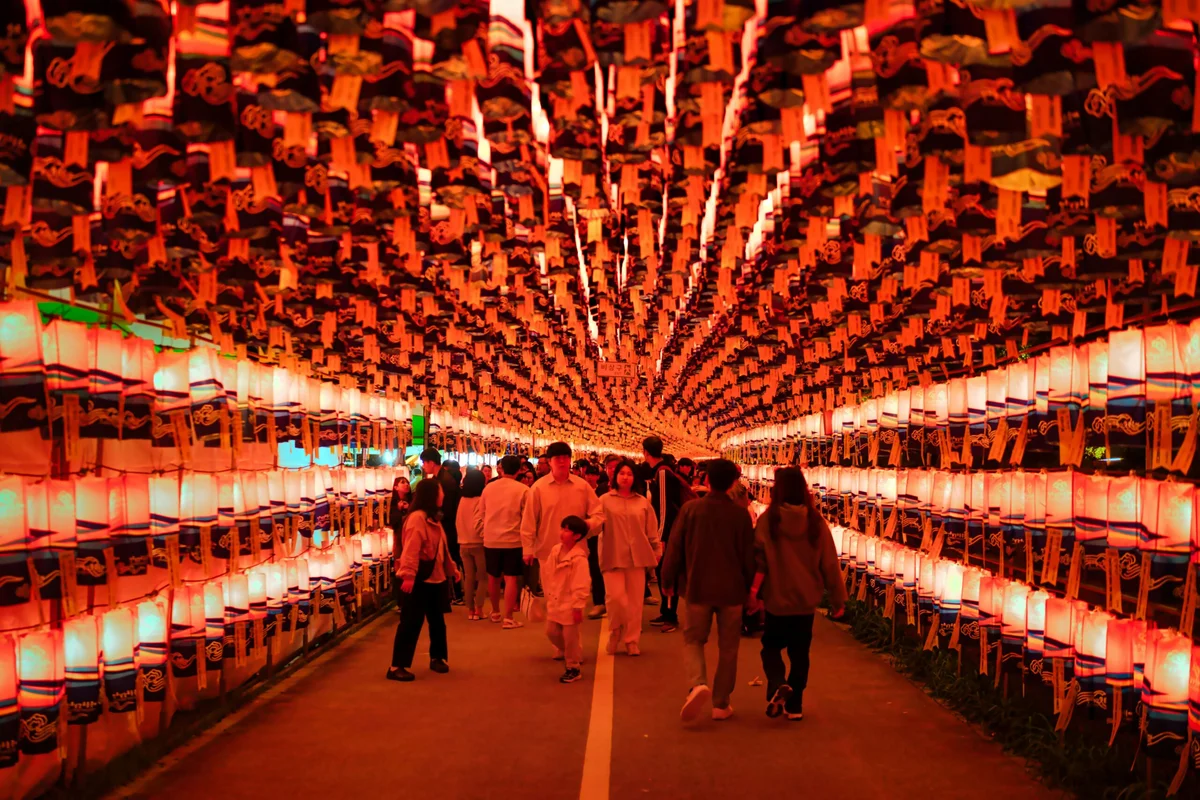
The Jinju Namgang Yudeung Festival is one of South Korea's largest traditional festivals. It takes place along the Nam River in Jinju, South Gyeongsang Province, with thousands of illuminated lanterns floated on the water over five to seven nights.
- 📅 Dates: early October 2026, typically October 3-9 (confirm at jinju.go.kr)
- 📍 Location: Nam River riverbanks, Jinju, South Korea
- 🎟️ Admission: main lantern displays are free. Paid options include lantern-making workshops and boat tours to see the floating lanterns from the river.
- ✈️ Access: fly to Busan Gimhae International Airport (PUS), then 1h bus to Jinju. Or take the KTX from Seoul to Jinju Station (2h30).
The festival marks the historical significance of the Nam River during the 1592 Japanese invasion of Korea. The lanterns originally served as signals between defenders. The tradition continues with a scale that draws over a million visitors across the full run.
- ✅ Arrive by 7pm for the best light. The lanterns are lit after dark and the river views peak around 9-10pm
- ✅ Book Jinju accommodation 4 to 6 weeks ahead. The city's hotels fill up and prices rise sharply during festival week
- ✅ The Saturday evening (midpoint of the festival) draws the largest crowds
Nada Fighting Festival (Kenka Matsuri), Japan (October 2026)
The Nada Kenka Matsuri at Matsubara Hachiman Shrine in Himeji is one of Japan's most intense traditional festivals. Portable shrines (mikoshi) from seven towns are deliberately crashed into each other by teams competing for territory. The collisions are coordinated, dangerous and spectacular.
- 📅 Dates: October 14-15, 2026
- 📍 Location: Matsubara Hachiman Shrine, Shingu-cho, Himeji, Hyogo Prefecture
- 🎟️ Admission: free. The procession and fighting areas are public
- 🚂 Access: Himeji Station is 20 minutes by train from Kobe (JR), or 30-40 minutes from Osaka (Shin-Osaka by Shinkansen). From Himeji Station, take a bus to Shingu-cho (approx. 20 min).
Each town's team wears different-coloured happi coats (traditional short coats). The collision sequence follows a strict ritual order: seven mikoshi are brought together on the second day in a contested area called the kenka-ba. Injuries are common and considered part of the honour.
- ✅ Combine with Himeji Castle the same day: it is a 10-minute walk from Himeji Station, 40 minutes from the shrine
- ✅ Arrive early on October 14 for the procession, October 15 for the main shrine confrontations
- ✅ Himeji hotels book out: stay in Kobe or Osaka and travel in on the day
Yi Peng and Loi Krathong, Thailand (November 2026)
Loi Krathong and Yi Peng fall on the same full moon evening in November. Loi Krathong is celebrated nationwide: small decorated floats (krathong) are released on rivers and canals. In Chiang Mai, Yi Peng overlaps it with mass lantern releases that fill the night sky.
- 📅 Dates: Yi Peng main release November 2-3, 2026 (follows the Thai lunar calendar; confirm at tourismthailand.org). Loi Krathong same weekend across Thailand
- 📍 Location: Chiang Mai (Yi Peng). Bangkok (Loi Krathong on the Chao Phraya River). Sukhothai (the most photogenic krathong celebration in the country)
- 🎟️ Admission: public events are free. Ticketed Yi Peng lantern events organized by temples or tour operators range from THB 1,000 to 3,000 (€26-78).
- ✈️ Access: fly into Chiang Mai International Airport (CNX) from Bangkok Suvarnabhumi (1h). Bangkok is well connected from Europe and North America with 10-12h direct flights.
The largest mass lantern release in Chiang Mai is organized by Mae Jo University in the days leading up to the main date. Thousands of lanterns are released simultaneously by monks and visitors. Tickets sell out months ahead.
- ✅ Book Chiang Mai accommodation 3 to 4 months before November: prices triple around Yi Peng week
- ✅ The Sukhothai Loi Krathong is less crowded than Chiang Mai and the historical park setting is exceptional
- ✅ Bring a small krathong to release yourself: sold for THB 30-50 at riverside stalls throughout the country
Trouvez votre hébergement à Chiang Mai
For Yi Peng in November, Chiang Mai hotels near the Old City and Nimmanhaemin fill up 3 to 4 months before the festival. Book early — prices triple in the week around the lantern release.
Diwali, India (October-November 2026)
Diwali is the Hindu festival of lights, celebrated over five days. In 2026 the main date falls around October 20 (confirm with official sources: the exact date follows the Vikram Samvat lunar calendar). Cities across India light up with diyas (oil lamps), fireworks, sweets and family gatherings.
- 📅 Main date: approximately October 20, 2026
- 📍 Best cities for visitors: Varanasi (ghats on the Ganges are lit with thousands of oil lamps), Jaipur (Palace of Winds illuminated), Amritsar (Golden Temple is spectacular at night), Mumbai (street celebrations in neighbourhoods like Dadar)
- 🛕 Varanasi specifics: the Diwali evening Ganga aarti at Dashashwamedh Ghat with Diwali additions is one of the most atmospheric events in India
- ✈️ Access: fly into Varanasi (VNS), Jaipur (JAI) or Amritsar (ATQ). All connect from Delhi (DEL) and Mumbai (BOM) with 1-2h domestic flights.
Diwali is a national holiday in India. Markets, transport and accommodation become congested. Book domestic trains and hotels 6 to 8 weeks ahead. Train tickets sell out particularly fast on the Diwali weekend.
- ✅ Varanasi is the most rewarding Diwali destination for first-time visitors to India
- ✅ Book a boat on the Ganges for the evening of Diwali: views of the illuminated ghats from the river are exceptional
- ✅ Ear protection is useful: the fireworks in Indian cities on Diwali night are intense and sustained
Restez connecté sur place
Une eSIM pour avoir internet dès l'atterrissage, sans changer de carte SIM.
Planning an Asia fall festival trip
Fall is one of Asia's best travel seasons. The monsoon retreats from most of South and Southeast Asia by October, leaving clear skies and lower humidity. Japan and Korea enter peak foliage season in November.
- ✅ Combine festivals: Jinju (Oct 3-9) + Himeji Kenka Matsuri (Oct 14-15) is doable in one two-week Japan-Korea trip with a Seoul stopover
- ✅ Yi Peng or Loi Krathong: choose one city and commit. Hopping between Chiang Mai and Bangkok on the same night is not practical
- ✅ eSIM on arrival: most of Asia has excellent mobile data coverage. A local eSIM is the cheapest option for navigation and translation
- ✅ Travel insurance: medical costs in Japan and South Korea are manageable but can be significant without insurance. India and Thailand also recommend comprehensive cover
For Japan traditional festivals in more depth, read our Japan fall festivals guide.